From Feature Factory to Value Engine: Redefining Product Leadership for Growth
There’s a moment in almost every growth-stage company where product starts to lose its way. The team is shipping, sometimes a lot, but no one can really say if it’s working. The backlog keeps growing and product managers are constantly busy, but not necessarily effective.
This is what many call a feature factory. Great to put a name to it, but how do we get out of it and shift the organisation toward something more intentional? Towards creating a value engine?
If you're a product leader stepping into a fast-moving scale-up (or even a more established growth-stage company where the value isn't clear), this is the shift you're likely needing to implement and lead. And it doesn’t happen through frameworks or vision decks. It happens in how your team works day-to-day, how decisions get made, and how the business sees product’s role in growth.
Feature Factory vs Value Engine
Here’s a quick comparison of what we’re really talking about:
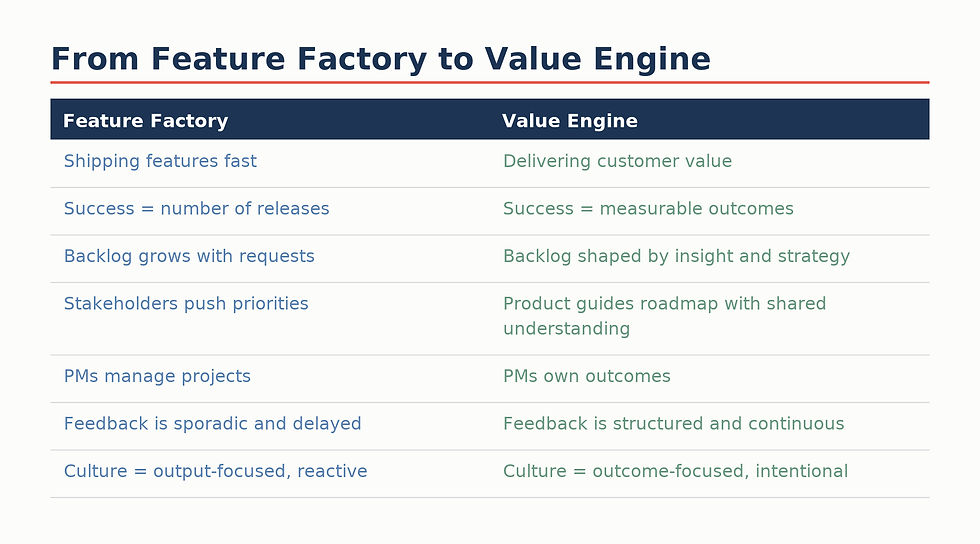
The feature factory isn’t always chaotic. In fact, it can feel productive - releases go out and everyone’s working hard.
But the outputs often fail to connect to results, users don’t adopt what’s built, sales and customer success aren’t aligned, and product feels stuck in a reactive loop.
How You Know You’re Stuck
This isn’t about labelling yourself or your team. But if these feel familiar, you may be operating more like a factory than an engine:
PMs can’t explain how what they’re building ties to business goals
Product reviews are only about demos, not decisions (such as, do we ship, delay or iterate, did this feature meet its intended outcome)
The roadmap is a list of requests from sales, rather than reflecting the product strategy (in terms of customers, growth goals, product vision and positioning, etc)
Feedback loops are missing or inconsistent
Success is measured in shipping velocity, not adoption or impact
Product managers are drowning in delivery work, with no space for strategic thinking
It’s easy to end up here, especially in companies growing fast or managing through change.
Getting out of it doesn’t mean slowing down, but shifting how your team defines value and how that value is delivered.
How To Make the Shift
The success of this shift doesn't lie only within product, but as a product leader you can start by changing what your team pays attention to and how the business thinks about product.
1. Redefine What Success Looks Like
Stop measuring success by how much you ship. Start measuring by what changes because of it.
It’s easy to default to output: releases, story points, lead time, cycle time. But those are internal signals and don’t tell you if customers actually got any value.
What to do:
Set clear success criteria before you build. Before a ticket hits development, define what a successful outcome looks like - whether it’s higher activation, reduced drop-off, fewer support tickets, or improved Time to Value (TTV). Don’t make “feature shipped” the end goal.
Bring metrics into planning and retros. Get the team into the habit of checking whether the success criteria has actually been met or whether we are moving toward achieving the success criteria. If not, treat it as a learning opportunity, not failure.
Tell the story of impact, not delivery. When you talk to stakeholders or execs, stop showing them a feature list. Show them what changed because of what you built.
2. Create Space for Thinking, Not Just Doing
If your PMs are buried in Jira, they don’t have time to be strategic.
When everyone is at full capacity all the time, you end up with a very reactive team and focus typically defaults to tactical work. Strategic work needs space: time to reflect, to explore data, to talk to customers, to think.
What to do:
Reduce work in progress. Start fewer things and finish more. Fewer parallel tracks give your team breathing room, which is where better ideas happen.
Block “thinking” time and defend it. Carve out protected time in your team’s schedule for research and strategic planning. If it’s not on the calendar, it won’t happen.
Make insight visible early. Don’t wait until you have a “full discovery deck.” Share a note, a snippet, or a chart. This signals that strategic thinking is valued.
Shift what you praise. Celebrate someone pulling apart a complex problem or running a thoughtful customer interview, not just hitting a deadline.
3. Shift from Request-Based Roadmaps to Problem-Led Planning
Collecting feature requests is not strategy — it’s just keeping a list of what people are asking for.
Stakeholders will always bring requests for features: “We need X for client Y.” But Product’s job is to dig deeper, to understand what problem this is solving, and is it the right one to solve?
What to do:
Turn requests into problems. When someone says, “We need a dashboard,” ask: “What decision are they trying to make? What’s blocking them now?” Teach the org to describe needs in terms of problems.
Create a shared format for intake. Even a simple “problem–impact–urgency-reusability” template will lift the quality of roadmap discussions.
Use customer insights to shape the backlog. Show stakeholders the real data: support tickets, churn reasons, funnel drop-offs. Let them see that you're not ignoring their input, but that you are making data driven decisions.
Frame prioritisation as shared responsibility. Don’t disappear for four weeks and come back with a final roadmap. Involve others in the process and keep the final decision anchored in strategy, not volume of requests.
4. Build Feedback Loops You Can Trust
You can’t create value if you don’t know what’s working.
If the only feedback you get is when something breaks, a customer complains or leaves, you're always too late. Feedback loops should be part of your normal operating rhythm.
What to do:
Get consistent customer input. Book 2–3 customer calls every week. Rotate team members in. You don’t need a big research team!
Align with GTM teams weekly. Sales and Customer Success hear things you won’t. But they don’t always know what to surface. Run a 15-minute weekly (even every other week) sync just to share patterns - what’s working, what’s not landing, what’s coming up. (You don't need to set up your own meeting - join one of their weeklies)
Use fast, lightweight tools. Post-release micro surveys, usability heatmaps, funnel analytics - whatever gives you real usage insight quickly, based on the success criteria you set.
Show what changed because of feedback. Nothing builds trust like showing your internal team or customer that you listened and acted. Even small changes, when explained, create momentum.
5. Help the Business See Product Differently
If product is seen as the “ticket takers,” that’s how it’ll be used.
The business often doesn’t resist product strategy, it just doesn’t see it. Your job as a product leader is to create visibility and help everyone understand how product drives the business forward.
What to do:
Narrate the roadmap in terms of value. Instead of “Q4 we’ll release user management,” say: “We’re unlocking self-serve for scaling customers so Customer Success can focus on retention.”
Bring insights, not opinions, to leadership. Use product data - adoption rates, churn points, friction metrics - to support decisions. It makes product strategic, not subjective.
Use simple language. Drop the jargon. Talk in terms of customer pain, revenue risk, operational efficiency - whatever matters most to your execs.
Involve other functions early. Don’t just inform Sales, Marketing and Customer Success - collaborate with them. If they help shape the roadmap, they’ll be your biggest advocates, not blockers.
Final Thought
Turning a feature factory into a value engine isn’t about working harder or doing more. It’s about creating clarity for your team, for your stakeholders, and for the business.
It starts by changing what you measure, how you prioritise, and how you talk about the work.
You won’t get it perfect. You won’t fix it overnight. But if you can help your team focus on outcomes, not outputs and bring the rest of the org with you, the impact compounds fast.
And suddenly, product stops being the place where things get built. It becomes the place where growth begins.
Need help making the shift?
If your team is stuck in delivery mode and you’re trying to shift towards more value-led product leadership?
I help growth-stage B2B companies build product teams that drive outcomes, not just output. Whether you need a clearer roadmap, stronger cross-functional alignment, or space for your PMs to think more strategically - let’s talk.
Book a free exploratory call and structure a plan around your current needs!


Comments